
Service
NeuCologne Carnival 2027: The Ultimate First-Timer’s Guide for International Visitors

Planning to experience Cologne Carnival for the first time? From colorful costumes and lively street parties to traditional Kölsch beer, spectacular parades, and local customs, here’s everything international visitors need to know about Germany’s famous Carnival celebration.
Imagine arriving in a German city where thousands of people are dressed as pirates, clowns, superheroes, animals, and fantasy characters. Music fills the streets, strangers sing together, and entire neighborhoods turn into enormous outdoor parties.
Welcome to Cologne Carnival!
Known locally as Kölner Karneval or Fastelovend, Cologne Carnival is one of Germany’s biggest and most beloved cultural celebrations.
But if you’re visiting from another country, your first Cologne Carnival can be a little overwhelming.
When should you visit? Do you need a costume? Where are the best places to celebrate? What does “Kölle Alaaf” mean? And why is everyone shouting “Kamelle” during the parade?
This guide explains everything you need to know to enjoy Cologne Carnival like a local.
What Is Cologne Carnival?
Cologne Carnival is a traditional festival celebrated every year in Cologne, a historic city on the Rhine River in western Germany.
Locals often call Carnival the “fifth season”, because it’s such an important part of the city’s identity.
The Carnival season officially begins on November 11 at 11:11 a.m. However, the biggest celebrations take place during the final days before Ash Wednesday, usually in February or March.
During these days, Cologne transforms into a city of costumes, music, parades, street celebrations, and traditional Carnival events.
Unlike many festivals where visitors simply watch performances, Cologne Carnival encourages everyone to participate.
You don’t have to be German, speak the local dialect, or understand every tradition to join the celebrations.
All you really need is a little curiosity, a good costume, and a willingness to have fun.
The modern organized Cologne Carnival dates back to 1823, although its roots are much older.
Today, it combines traditional customs, political satire, music, community spirit, and a strong sense of local identity.
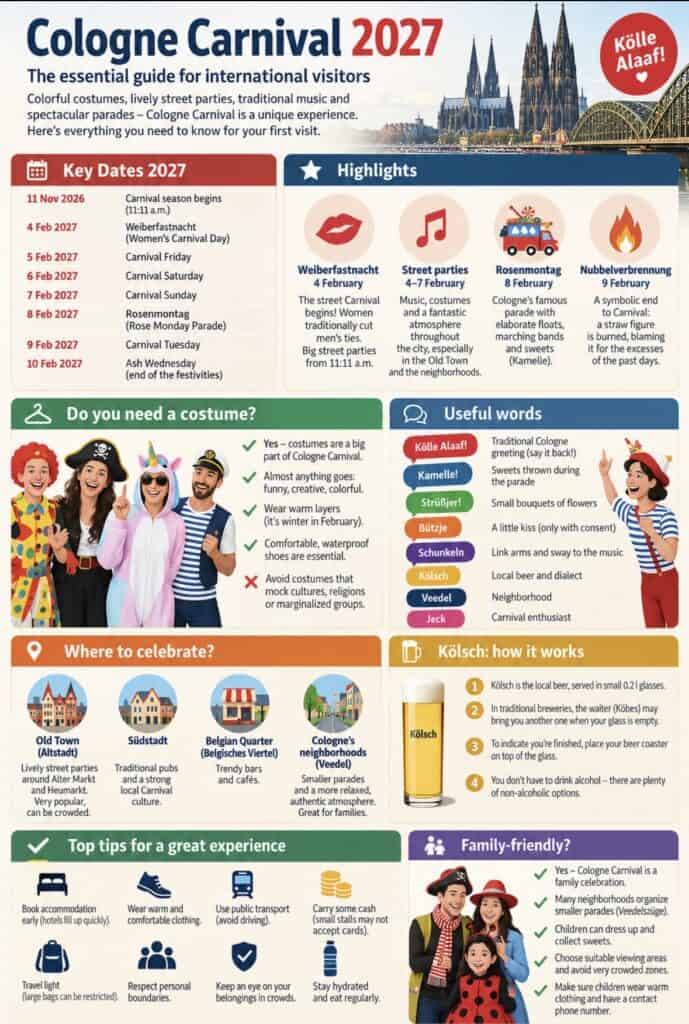
Cologne Carnival 2027: Important Dates
If you’re planning a trip to Cologne, choosing the right dates is essential.
Here are the key dates for Cologne Carnival 2027:
| Event | Date |
| Carnival season begins | November 11, 2026 |
| Weiberfastnacht (Women’s Carnival Day) | Thursday, February 4, 2027 |
| Carnival Friday | Friday, February 5, 2027 |
| Carnival Saturday | Saturday, February 6, 2027 |
| Carnival Sunday | Sunday, February 7, 2027 |
| Rosenmontag (Rose Monday) | Monday, February 8, 2027 |
| Carnival Tuesday | Tuesday, February 9, 2027 |
| Ash Wednesday | Wednesday, February 10, 2027 |
Our recommendation: If you’re visiting Cologne Carnival for the first time, try to stay from Thursday through Monday.
This gives you the opportunity to experience the opening of the street Carnival, explore different neighborhoods, and enjoy the famous Rose Monday Parade.
If you only have one day, choose Thursday for the street-party atmosphere or Monday for the spectacular parade.
Do You Need a Costume for Cologne Carnival?
One of the first things international visitors should understand is that wearing a costume is a huge part of Cologne Carnival.
In fact, you’ll probably feel more out of place wearing normal clothes than dressing up as something completely ridiculous.
Almost anything goes.
Popular costume ideas include pirates, superheroes, animals, clowns, astronauts, historical characters, and imaginative homemade creations.
You don’t need an expensive or elaborate costume. A colorful wig, funny hat, or creative outfit can be enough.
However, avoid costumes that mock cultures, religions, or marginalized groups.
Important: Cologne Carnival Takes Place in Winter
This is something many international visitors underestimate.
Unlike Carnival in Rio de Janeiro, Cologne Carnival takes place during the German winter.
In February, temperatures can be close to freezing, and rain or strong winds are possible.
A thin party costume might look fantastic indoors but become extremely uncomfortable after several hours outside.
Wear warm layers underneath your costume, choose comfortable waterproof shoes, and bring a jacket if necessary.
You’ll enjoy the celebrations much more if you’re warm and dry.
What Does “Kölle Alaaf” Mean?
If there’s one phrase you absolutely need to learn before visiting Cologne Carnival, it’s:
Kölle Alaaf!
This is Cologne’s traditional Carnival greeting and battle cry.
It roughly expresses the idea of “Cologne above all!” or “Long live Cologne!”
You’ll hear it everywhere: in pubs, during parades, at Carnival events, and on the streets.
When someone shouts “Kölle Alaaf!”, feel free to shout it back.
But here’s an important local detail.
In Düsseldorf and several other German Carnival cities, people traditionally shout “Helau.”
Cologne, however, proudly uses “Alaaf.”
Shouting “Helau” in a Cologne Carnival pub might earn you some playful disapproval from the locals.
Why Is Everyone Singing German Songs?
Music is one of the most important parts of Cologne Carnival.
And it’s not just international pop music or typical party hits.
Cologne has its own musical culture, with countless Carnival songs performed in German and the local dialect, Kölsch.
Some of the city’s best-known bands include:
- Brings
- Höhner
- Kasalla
- Cat Ballou
- Bläck Fööss
Their songs often celebrate friendship, love, community, and life in Cologne.
You may not understand the lyrics at first, but don’t worry.
You’ll quickly notice that locals know the words by heart and enthusiastically sing along.
One traditional activity is called Schunkeln.
People link arms and sway together from side to side in time with the music.
If someone invites you to join, it’s a wonderful way to experience Cologne’s welcoming Carnival atmosphere.
Of course, participation is always your choice.
Weiberfastnacht: When Cologne’s Street Carnival Begins
Thursday, February 4, 2027, marks the official beginning of the street Carnival.
The celebrations traditionally start at 11:11 a.m.
One of the most famous opening events takes place at Alter Markt, a historic square in Cologne’s Old Town.
Thousands of costumed revelers gather to celebrate, sing, dance, and welcome the start of the festivities.
Many pubs open early, and the celebrations continue throughout the day.
Why Do Women Cut Off Men’s Ties?
Weiberfastnacht, sometimes translated as Women’s Carnival Day, has a particularly unusual tradition.
Women may symbolically cut off men’s neckties.
The custom reflects the Carnival tradition of temporarily turning everyday social hierarchies upside down.
However, visitors should remember that this is a playful custom, not permission to damage someone’s clothing without consent.
Another tradition is the Bützje, a small Carnival kiss, usually on the cheek.
As with any physical contact, consent is essential.
Where Should You Celebrate?
The Old Town around Alter Markt and Heumarkt is a popular place for first-time visitors.
However, these areas can become extremely crowded.
The Zülpicher Straße area is also known for large Carnival gatherings, particularly among younger people, but it can experience significant crowd-control measures.
If you prefer a more relaxed atmosphere, explore Carnival celebrations in Cologne’s neighborhoods instead.
Rosenmontag: Cologne’s Famous Rose Monday Parade
For many international visitors, Rose Monday is the highlight of the entire Carnival season.
In 2027, Rosenmontag falls on Monday, February 8.
On this day, Cologne hosts its famous Rosenmontagszug, the Rose Monday Parade.
The parade features elaborately decorated floats, marching bands, dancers, Carnival societies, and thousands of participants.
One of its most distinctive elements is political satire.
Some floats humorously criticize politicians, world events, and current social issues.
This is an important part of Cologne Carnival’s history: the festival is not only about partying but also about humor, freedom of expression, and social commentary.
What Are “Kamelle”?
During the parade, participants throw sweets into the crowd.
These sweets are called Kamelle.
If you want some, shout:
Kamelle! Kamelle!
You may also hear people shouting Strüßjer, which means small bouquets of flowers.
Bring a small bag if you’d like to collect sweets.
For safety, keep a reasonable distance from moving floats, watch out for thrown objects, and supervise children carefully.
Is the Rose Monday Parade Free?
Yes. You can watch the parade for free from publicly accessible areas along its route.
However, certain reserved grandstands and special viewing areas require tickets.
The most popular locations can become crowded, so arriving early is recommended.
Always check the official parade route and any security restrictions before your visit.
The Best Places to Celebrate Cologne Carnival
Cologne offers different Carnival experiences depending on what you’re looking for.
Cologne Old Town (Altstadt)
The historic Old Town is one of the best-known areas for Carnival celebrations.
Around Alter Markt and Heumarkt, you’ll find traditional Carnival music, costumed crowds, pubs, and an energetic atmosphere.
It’s a good starting point for first-time visitors, although it can get very busy.
Südstadt
Cologne’s southern inner-city neighborhoods have a strong local Carnival culture.
Many traditional pubs and neighborhood events offer a more community-oriented experience.
Belgian Quarter (Belgisches Viertel)
This trendy neighborhood has numerous bars, cafés, and pubs.
Some venues host Carnival celebrations, although programs and admission policies vary.
Cologne’s Neighborhoods (Veedel)
If you want to experience Carnival beyond the busiest tourist areas, explore the local neighborhoods, known as Veedel.
Many organize smaller parades and community celebrations.
These can be particularly enjoyable for families or visitors interested in experiencing Cologne’s local traditions.
Drinking Kölsch: What Visitors Should Know
If you visit Cologne, you’ll probably encounter Kölsch.
The word refers both to Cologne’s local dialect and its traditional beer.
Kölsch beer is typically served in small, narrow glasses holding 0.2 liters.
In traditional breweries, waiters known as Köbes may automatically bring you another beer when your glass is empty.
To indicate that you’re finished, place your beer coaster on top of your glass.
However, during Carnival, many pubs operate differently, with self-service, immediate payment, or special event arrangements.
You don’t need to drink alcohol to enjoy Cologne Carnival.
There are plenty of ways to celebrate through music, parades, costumes, and local traditions.
If you do drink, remember to stay hydrated and eat regularly.
7 Mistakes First-Time Carnival Visitors Should Avoid
1. Booking Accommodation Too Late
Carnival is one of Cologne’s busiest periods.
Hotels can fill up quickly, and prices may rise significantly.
Book your accommodation as early as possible.
2. Wearing an Impractical Costume
Remember that you’ll be celebrating in winter.
Comfortable shoes, warm layers, and weather-resistant clothing are essential.
3. Driving Into the City Center
Road closures, parade routes, and heavy traffic can make driving difficult.
Public transportation is generally the better option, although services may be crowded or temporarily rerouted.
4. Bringing Only a Credit Card
Many businesses accept cards, but some smaller stalls and temporary vendors may prefer cash.
Carry a modest amount of cash for convenience.
5. Carrying Large Bags
Large backpacks are inconvenient in crowded areas and may be restricted at certain events.
Travel light and keep your valuables secure.
6. Ignoring Personal Boundaries
Carnival is friendly and social, but everyone deserves respect.
Never assume that costumes, drinking, or traditional customs make unwanted touching or kissing acceptable.
7. Underestimating the Crowds
Popular Carnival locations can become extremely busy.
Arrange meeting points with friends, keep your phone charged, and follow instructions from police and event organizers.
Is Cologne Carnival Family-Friendly?
Absolutely.
Although Cologne Carnival is famous for its lively street parties, it’s also a family celebration.
Many neighborhoods organize smaller Carnival parades, known as Veedelszüge.
These often provide a more manageable environment for families with children.
Children can dress up, enjoy the music, and collect sweets during the parades.
Parents should choose suitable viewing areas, avoid heavily crowded party zones, and ensure children have appropriate clothing for the weather.
It’s also helpful to give children a contact phone number in case they become separated from their family.
What Should You Pack for Cologne Carnival?
Before heading out for a day of celebrations, make sure you have:
- A comfortable, warm Carnival costume
- Waterproof shoes
- Warm clothing underneath your costume
- A small bag for personal belongings
- Some cash
- A charged smartphone
- A portable power bank
- Water and a small snack
- A rain jacket if necessary
For the Rose Monday Parade, bring an extra bag to collect Kamelle.
Do You Need to Speak German?
No.
Many people in Cologne speak English, especially in hotels, restaurants, and tourist-oriented businesses.
However, learning a few local expressions will make your Carnival experience more enjoyable.
Essential Cologne Carnival Vocabulary
| Kölsch / German | English meaning |
| Kölle Alaaf | Traditional Cologne Carnival cheer |
| Fastelovend | Carnival |
| Jeck | Carnival enthusiast or reveler |
| Kamelle | Sweets thrown during parades |
| Strüßjer | Small bouquets of flowers |
| Bützje | Little kiss |
| Schunkeln | Linking arms and swaying to music |
| Kölsch | Cologne dialect and local beer |
| Veedel | Neighborhood |
| Rosenmontag | Rose Monday |
| Weiberfastnacht | Women’s Carnival Day |
| Rosenmontagszug | Rose Monday Parade |
Even if you only remember “Kölle Alaaf,” you’ll already be speaking a little like a local.
A Suggested Four-Day Cologne Carnival Itinerary
If you’re visiting Cologne for the first time, here’s a simple itinerary.
Thursday, February 4: Experience Weiberfastnacht
Start your day in the Old Town and experience the opening of the street Carnival.
Explore the festivities, enjoy traditional music, and get used to Cologne’s Carnival atmosphere.
Friday, February 5: Discover Local Carnival Culture
Visit different neighborhoods, explore traditional pubs, and experience Cologne beyond the busiest tourist areas.
In the evening, consider attending a Carnival concert or ticketed event.
Saturday or Sunday, February 6–7: Enjoy Neighborhood Celebrations
Look for local parades, community celebrations, and traditional Carnival events.
If you’re traveling with children, this is a good opportunity to find family-friendly activities.
Monday, February 8: Watch the Rose Monday Parade
Head to the parade route early, find a suitable viewing spot, and enjoy Cologne’s biggest Carnival spectacle.
Remember to shout “Kamelle!” when the floats pass.
If you stay longer, consider attending a traditional Nubbelverbrennung on Carnival Tuesday.
During this unusual custom, a straw figure called the Nubbel is symbolically blamed for the excesses of Carnival and then burned.
Ash Wednesday marks the end of the festivities.
Frequently Asked Questions About Cologne Carnival
Is Cologne Carnival worth visiting?
Yes, especially if you enjoy cultural festivals, music, costumes, and lively public celebrations. It’s one of Germany’s most distinctive traditional events.
Can tourists join Cologne Carnival?
Absolutely. International visitors are welcome to participate in public celebrations and parades as spectators.
Is Cologne Carnival free?
Many street celebrations and public parades are free. Certain concerts, Carnival balls, traditional sessions, and reserved viewing areas require tickets.
Do I have to wear a costume?
No, but wearing one is strongly recommended. Costumes are a central part of the Carnival experience.
Is Cologne Carnival safe for tourists?
Cologne Carnival is a major public event with organized security measures. As at any crowded festival, visitors should take precautions, protect valuables, respect personal boundaries, and follow official instructions.
Can I celebrate without drinking alcohol?
Of course. Carnival is about music, traditions, community, and enjoying the festive atmosphere. Alcohol is optional.
Which day is best for first-time visitors?
Thursday is ideal for experiencing street Carnival, while Rose Monday is the best choice if you want to see Cologne’s famous parade.
Final Thoughts: Experience Cologne Carnival Like a Local
Cologne Carnival is much more than a costume party.
It’s a celebration of community, tradition, humor, and the unique character of Cologne.
For first-time international visitors, the experience can feel a little chaotic at first.
People sing songs you don’t understand, strangers link arms and sway together, and adults walk through the streets dressed as pirates, animals, or cartoon characters.
But that’s exactly what makes the festival special.
Come with an open mind, dress warmly, wear a costume, and don’t be afraid to join the celebrations.
You might arrive in Cologne as a tourist, but after a few days of Carnival, you’ll understand why locals are so passionate about their beloved Fastelovend.
Kölle Alaaf — and welcome to Cologne Carnival 2027!
Wie gefällt dir dieser Beitrag?
Mitreden